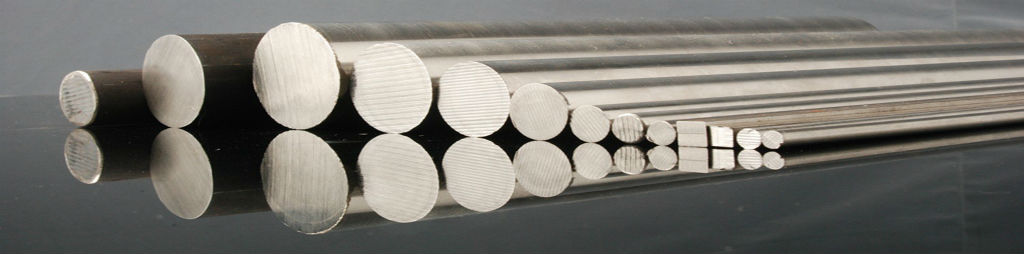
1018 STEEL
What 1018 steel is used for
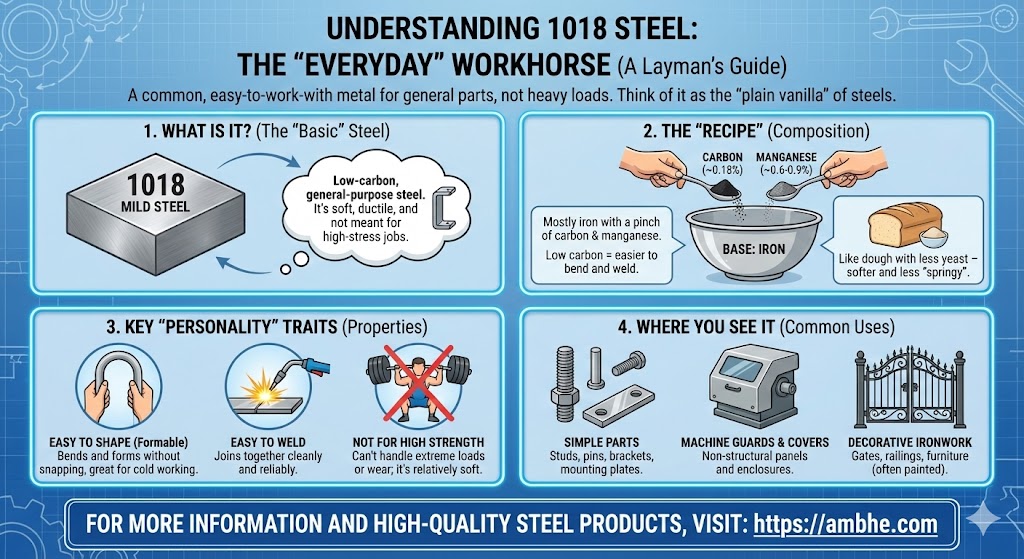
1018 is a low-carbon steel with roughly 0.18% carbon and 0.60 to 0.90% manganese, plus small amounts of phosphorus and sulphur. The low carbon and the moderate manganese make it easy to machine, easy to weld and easy to form, and 1018 is one of the most widely used general engineering grades as a result.
Manganese is the element to look at. At 0.60 to 0.90% it runs higher than commercial quality steel and higher than AISI 1020, which gives 1018 a better response to carburising when a part has to be case hardened. Hot rolled 1018 also comes out stronger than commercial quality round bar, so you get a usable mix of strength, ductility and hardness without paying for an alloy grade.
Typical parts are gears, shafts, pins, studs, bolts, fasteners, farm implements and general industrial machinery, mostly components that are machined and are not carrying high stress. 1018 is a general engineering steel, not a structural one. For structural work the right specification is IS 2062 or A36.
It is also inexpensive next to alloy steels and easy to source, which is usually why it ends up on the drawing in the first place.
SAE 1018 cold drawn bright bar
1018 cold draws well. In the bright cold drawn condition the bar takes higher stress than the same section hot rolled, and the gain shows up most on smaller diameters.
Against black mild steel, bright mild steel holds tighter sectional tolerance, runs straighter and has a much cleaner surface. The practical benefit is that the bar arrives closer to finished machine size, so there is less metal to remove and machining cost drops. Cold drawn bar is also stronger than hot rolled bar of the same section.
Rolling temperature, draft and drawing parameters all affect the final properties, and drawing after hot rolling improves machinability considerably.
Applications
Typical applications of 1018 round bar are gears, bright bars, pins, studs, bolts, farm implements and general industrial machinery.
Sizes we offer in 1018
- Rounds – 23.5mm to 80mm
- Bright Bars – 21mm to 63.5mm
- Hexagons Black from 23.5mm to 52.5mm
- Hexagon Bright bar from 22mm to 50mm
Ordering information
To place an order we need the following.
| Grade | SAE 1018 |
|---|---|
| Order | Minimum order 3 MT per size |
| Length |
|
| Diameter | 23.5 mm to 80 mm |
| Condition |
To request a quote, fill in this form.
Typical chemical composition
| Element | Percent by weight |
|---|---|
| Carbon | 0.15-0.20 |
| Manganese | 0.60-0.90 |
| Phosphorus (max) | 0.040 |
| Sulphur (max) | 0.050 |
SAE 1018 is a plain carbon steel, so it is magnetic.
Mechanical properties
1018 is supplied in the as-rolled or as-drawn condition, not hardened and tempered, so the properties depend on how the bar was finished rather than on a heat treatment cycle. Neither table below is a guaranteed specification; the test certificate issued with your consignment is.
Typical values from our own bars:
| Condition | Tensile strength, MPa | Yield strength, MPa | Elongation, % | Hardness, HB |
|---|---|---|---|---|
| Hot rolled | 440 to 520 | 240 to 290 | 20 to 25 | 126 to 149 |
| Cold drawn | 520 to 600 | 380 to 450 | 15 to 18 | 150 to 180 |
| Cold drawn and stress relieved | 490 to 580 | 350 to 420 | 16 to 20 | 145 to 170 |
Published AISI typical values for the same grade, for comparison:
| Condition | Tensile strength, MPa | Yield strength, MPa | Elongation, % | Reduction of area, % | Hardness, HB |
|---|---|---|---|---|---|
| Hot rolled | 400 | 220 | 25 | 50 | 116 |
| Cold drawn | 440 | 370 | 15 | 40 | 126 |
Our hot rolled bar runs roughly 10% above the AISI typical. The billet and the reduction ratio we work at account for the difference. Write any acceptance criterion against the test certificate rather than against a handbook figure.
Equivalent grades
1018 is a US designation. The nearest designations in the other national standards are below.
| Standard | Designation |
|---|---|
| UNS | G10180 |
| Germany, W.Nr and DIN | 1.0453, C16.8 |
| United Kingdom, BS 970 | 080A17 |
| France, AFNOR | A33-101 AF42 |
| Italy, UNI | C20 |
Cross-reference charts commonly go wrong in two places. There is no exact JIS equivalent for 1018: S17C sits against 1017 and S20C sits against 1020, and the 1018 row is blank. The BS equivalent is 080A17, not En3B, which is 070M20 and belongs with 1020.
Equivalents are close matches, not substitutions. Where a drawing calls up a specific standard, order to that standard and we will roll to it.
1018 compared with 1020
These two grades get substituted for each other more often than any other pair of low-carbon steels, usually on the assumption that carbon is what separates them. Manganese is the real difference.
| Property | 1018 | 1020 |
|---|---|---|
| Carbon, % | 0.14 to 0.20 | 0.17 to 0.23 |
| Manganese, % | 0.60 to 0.90 | 0.30 to 0.60 |
| Tensile strength, hot rolled, MPa | 400 | 380 |
| Tensile strength, cold drawn, MPa | 440 | 420 |
| Hardness, cold drawn, HB | 126 | 121 |
| Machinability, 1212 rated at 100% | 78% | 72% |
1018 carries close to twice the manganese of 1020, which gives it the better response to carburising, the higher strength in both the hot rolled and the cold drawn condition, and the faster machining rate. The chemistry and strength figures are the published AISI values for the two grades. The machinability numbers come from our own machinability comparison chart, which rates a range of grades against free-cutting 1212.
In practice, specify 1018 if the part will be case hardened, or machined in volume where tool life and cycle time decide the cost. If it is being formed or welded and neither of those applies, 1020 will usually do the job.
Case hardening and carbonitriding
1018 is a case hardening grade in the light-duty sense. At 0.15 to 0.20% carbon it will not through-harden, but the surface takes carbon, or carbon and nitrogen, readily, and the higher manganese helps the response.
The boundary is well established. Carbonitriding extends carbon steels such as 1016, 1018, 1019 and 1022 into light-duty gearing, because it allows oil quenching on teeth of eight diametral pitch and finer. Where that is the application, material should be specified silicon-killed and fine-grain, which is what keeps case hardness and dimensional control uniform. The core behaves as oil-quenched low-carbon steel, and in the thin sections of fine-pitch teeth it can reach about 25 HRC.
There is a limit to this. For loaded gears, splines and shafts in real service, a case hardening alloy is the right specification, not 1018. We supply 16MnCr5, 20MnCr5 and 41Cr4 for exactly that work. 1018 belongs on pins, studs, bushes, low-load gears and any part where a hard skin over a soft core is enough.
About our company
Ambhe Ferro Metal Processors Private Limited rolls 1018 round bar at its own mills in Maharashtra, India. The plants are close to JNPT port and to the consumption centres of Mumbai, Thane, Pune, Nashik, Ahmednagar and Aurangabad.
We roll rounds, bright bars and hexagons across the size range listed above, to domestic and international specifications. Sizes outside the standard list can be developed where the requirement is regular and the quantity supports it.
Testing and packaging
We test and inspect the 1018 rounds and hexagons before they are packed. Which tests run depends on what the customer specifies: chemical composition, physical testing, visual inspection, macro and micro examination, NDT and ultrasonic testing. Third party inspection can be arranged. A test certificate covering the tests carried out goes with each consignment.
Bars are then bundled or packed so they are not damaged in transit.
For 1018 requirements call +91 9820063281 or +91 9987364999, or email sales@ambhe.com.
The equivalent designation for 1018 is UNS G10180.
Markets
We supply 1018 to customers in India and abroad.
In India we ship 1018 to Mumbai (Vasai Virar, Mira Bhayendar, Navi Mumbai), Pune (Pimpri Chinchwad, Chakan, Bhosari, Ranjangaon), Aurangabad (Waluj, Chikalthana), Nashik (Ambad, Satpur, Sinnar), Ahmednagar, Rajkot, Ahmedabad, Thane, Umergaon, Ambernath, Rabale, Nagpur, Kolhapur, Sangli, Belgaum, Bangalore, Goa and Chennai. Outside India, Dubai is a regular destination.
Frequently asked questions
Is 1018 the same as mild steel?
Broadly, yes. Mild steel is a loose commercial term for low-carbon steel, and 1018 is a specific grade within that family with a defined chemistry. If a drawing says mild steel, 1018 will normally satisfy it. If a drawing says 1018, unspecified mild steel will not necessarily satisfy that.
What is the difference between 1018 and 1020?
Manganese. 1018 carries 0.60 to 0.90% manganese against 0.30 to 0.60% for 1020. It is therefore slightly stronger in both the hot rolled and cold drawn condition, machines better at 78% against 72% on the 1212 basis, and responds better to carburising.
Can 1018 be case hardened?
Yes, by carburising or carbonitriding. It will not through-harden. Expect a hard case over a soft core, with the core reaching about 25 HRC in thin sections after oil quenching. For loaded gears and splines, 16MnCr5 or 20MnCr5 is the correct specification rather than 1018.
Is 1018 weldable without preheat?
In normal sections, yes. At about 0.18% carbon and under 0.90% manganese the carbon equivalent is low enough for all the common welding processes without preheat. Heavy sections, high restraint and low ambient temperature are the usual reasons to preheat.
What is the hardness of 1018 bar?
On our own bars, roughly 126 to 149 HB hot rolled and 150 to 180 HB cold drawn. The AISI typical figures are 116 HB hot rolled and 126 HB cold drawn. 1018 is supplied as rolled or as drawn, not hardened and tempered.
What is 1018 equivalent to in DIN and BS?
1.0453, also written C16.8, in the German system, and 080A17 in BS 970. The UNS number is G10180. There is no exact JIS equivalent: S17C sits against 1017 and S20C against 1020.
What sizes and lengths of 1018 do you supply?
Hot rolled rounds from 23.5 mm to 80 mm, bright bars from 21 mm to 63.5 mm, black hexagons from 23.5 mm to 52.5 mm and bright hexagons from 22 mm to 50 mm. Standard length is 5 to 6 metres and custom cut lengths can be supplied. Minimum order is 3 MT per size.
Is 1018 suitable for structural work?
No. 1018 is a general engineering grade for machined and case hardened components. Structural work should be specified to IS 2062 or A36.