
BRIGHT BAR
BRIGHT BAR
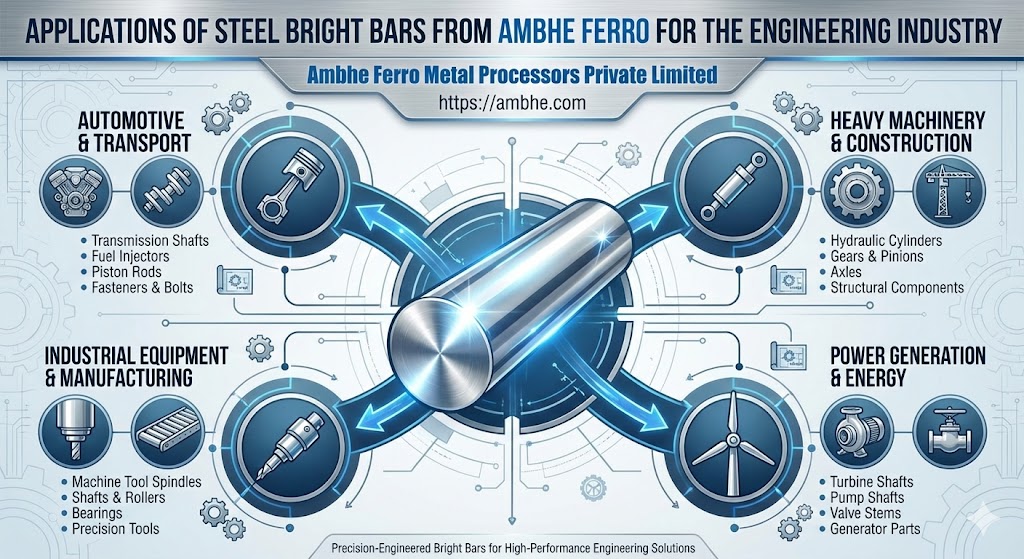
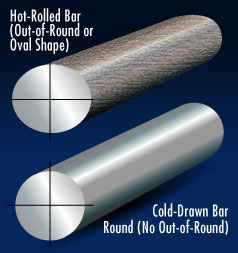
Bright Round Steel Bars are precision-engineered carbon and alloy steel bars characterized by a smooth, scale-free shiny surface and high dimensional accuracy. Unlike standard black bars, bright bars are processed through Cold Drawing, Peeling, or Centerless Grinding to achieve a superior finish (low Ra value) and straightness, making them ready for immediate use in CNC and high-speed machining operations.
Technical Specifications
At Ambhe Ferro Metal, our bright bars are manufactured to meet rigorous international standards, ensuring reliability for critical engineering applications.
- Dimensional Tolerance: We maintain tight tolerances (h9, h10, h11), typically between ±0.05mm and ±0.1mm, eliminating the need for further turning.
- Surface Finish: Smooth, polished, and free from surface defects such as seams or cracks.
- Standards Compliance: Fully compliant with IS 9550 (India), as well as ASTM, DIN, and AISI international standards.
Why Choose Ambhe Ferro for Bright Bars?
As a leading manufacturer of Bright Round and Hexagon Bars in India, we offer a distinct quality advantage:
- Integrated Manufacturing: We produce our own Hot-Rolled Steel Bars in-house to use as raw material for our bright bars. This ensures consistent chemical composition and mechanical properties.
- Sourcing Flexibility: For specialized requirements, we also source premium steel grades from reputable global manufacturers.
- Custom Sizes: Available in a wide range of diameters and grades customized to client specifications.
THE ADVANTAGES OF STEEL BRIGHT BARS ARE:
- Cold drawing of steel improves Size and Section which provides Tighter tolerances which Reduces machining losses.
- Improved Steel Surface Finish which Reduces surface machining & improves quality.
- Improved Straightness which Facilitates automatic bar feeding in CNC.
- It increases Mechanical Properties which Can reduce the need for hardening.
- It improves Machinability and Productivity which Enables higher machining feeds, high tool life, yield & speeds and improved machined finish.
SIZES WE MAKE IN BRIGHT BARS ARE:
- Bright Rounds: 22mm to 63.5mm
- Bright Hexagon Bars – 22mm to 50mm
Ordering Information
Want to Order?
Get competitive pricing and immediate delivery for Bright Bar Steel. Contact our Mumbai sales office today. MOQ 5000kg per size per grade.
(Response within 24 Hours)
Custom Manufacturing Capabilities
We offer bespoke bright steel bar manufacturing, capable of producing any metric or imperial size within our production range. If you have a regular, consistent requirement for a non-standard size, we can customise our drawing dies to meet your exact specs.
What Grades of Bright Steel Do We Manufacture?
We regularly produce high-precision cold drawn bars in a wide spectrum of Carbon and Alloy steel grades:
Mild Steel and Low Carbon: AISI 1018, 1035, 35C8
Free Cutting Steel (High Machinability): En1a, En1a (Leaded/Pb), En8M
Medium Carbon Steel: En8D, S45C, S48C
Case Hardening Steel: 16MnCr5, 20MnCr5
High Tensile Alloy Steel: SAE 4140, En19
Supply Network & Service Areas
We are a key supplier to OEM vendors and manufacturing units across India’s major industrial corridors:
Maharashtra: Mumbai, Thane, Nagpur, Kolhapur.
Pune Industrial Zone: Chakan, Bhosari, Ranjangaon.
Aurangabad Region: Waluj, Shendra.
Gujarat: Rajkot, Ahmedabad.
South & North India: Belgaum, Chennai, Delhi NCR.
Suitability & Forming Operations
Our bright bars are engineered for superior surface finish and straightness, making them ready for immediate processing. They are optimized for:
Machining: Turning, drilling, and slotting.
Fabrication: Cutting, punching, and knurling.
Forging: Cold and hot forging applications.
Who Uses Bright Round Steel Bars?
Our steel is primarily sourced by industries requiring high-speed production and precision tolerances.
1. CNC & VMC Machine Shops Facilities that need material with h9/h10/h11 tolerances to ensure smooth feeding in automatic machines with minimal material removal.
2. Automotive Component Manufacturers Tier 1 and Tier 2 vendors in hubs like Pune, Nashik, and Chennai producing shafts, fasteners, and engine components.
3. OEM Parts Manufacturers Businesses producing specialized machinery parts where surface finish and dimensional accuracy are critical.
Packaging and Traceability of Bright Bar
Packaging and Identification of Bright Steel Bars
Maintaining the premium quality of bright steel bars requires a dual-focused approach: rigorous protection of the cold-finished surface during transit and meticulous identification for complete material traceability.
Protective Packaging Process
Because the scale-free surface of bright bars is highly susceptible to oxidation (rust) and mechanical impact, multi-layered protection is essential.
- Rust Prevention: Bars are immediately coated with a high-grade rust-preventative oil or dewatering fluid after final inspection.
- Bundling & Strapping: Bars are grouped into bundles ranging from 500kg to 2000kg and secured with high-tension steel strapping to prevent movement.
- Protective Wrapping: Bundles are wrapped in materials matched to the transport conditions, such as VCI (Volatile Corrosion Inhibitor) paper, HDPE sheets, or traditional Hessian cloth to block moisture.
- Export Packing: For sea freight, bundles are often placed inside wooden boxes to provide maximum protection against salty air and rough handling.
Traceability and Identification
To ensure material authenticity and traceability from the mill to the end-user, robust identification methods are applied to every bundle.
- Durable Tagging: Every bundle is fitted with a weather-resistant metal or plastic tag.
- Critical Data: The tag clearly displays the supplier name, steel grade (e.g., En1a, AISI 1018), precise size and tolerance (e.g., 25mm h9), and net weight.
- Heat Number Traceability: Crucially, the unique Heat Number or Cast Number is linked on the tag to the original mill test certificate (MTC), ensuring complete quality pedigree.
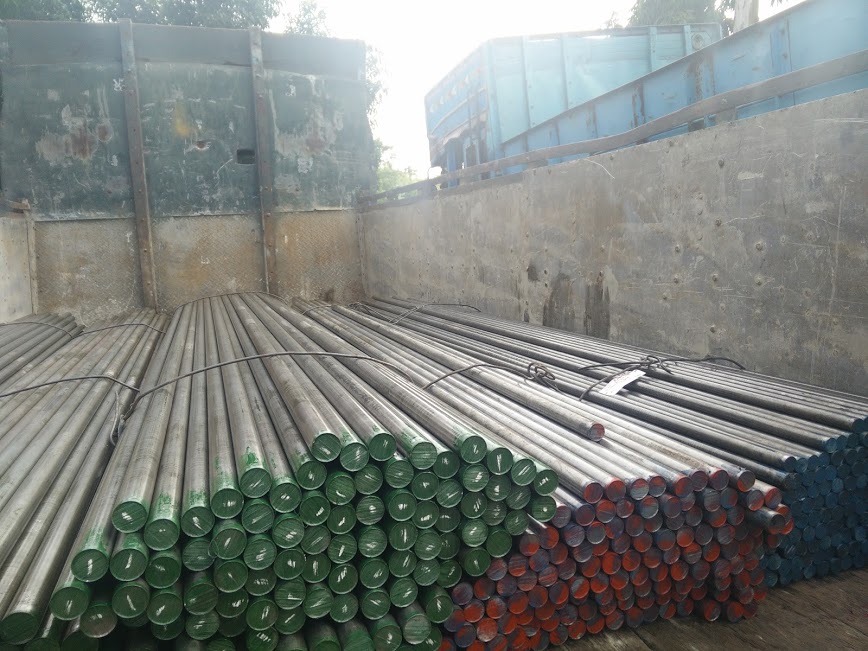
- Visual Color Coding: Standardized end color coding is often applied to the cut ends of the bars for rapid visual grade recognition in warehouse inventories.
Manufacturing Process: Hot Rolled to Cold Drawn Bright Bars (Shot Blasting Method)
This process outlines the conversion of rough hot-rolled steel into precise bright bars using **Shot Blasting** for descaling, followed by cold drawing to achieve superior dimensional accuracy and improved mechanical properties.
1Raw Material Inspection
The process begins with **Hot Rolled Steel Rounds** (Black Bars). These bars have a rough, dark surface covered in iron oxide scale.
- Action: The input material is rigorously inspected for surface defects, cracks, and verified for correct chemical composition against the required grade standards.
2Shot Blasting (Mechanical Descaling)
Before drawing, the abrasive iron oxide scale must be completely removed to prevent immediate damage to the expensive drawing die. Unlike chemical pickling, this process uses mechanical force.
- Process: The hot-rolled bars are passed through an automated **Shot Blasting Machine**. High-velocity steel shots (small metallic pellets) are blasted against the bar's surface from multiple angles.
- Result: The impact fractures and removes all rust and scale, leaving a clean, matte metal surface. The slightly textured finish created by shot blasting also aids in retaining lubricants during the drawing phase.
3Swaging (Pointing)
To initiate the drawing process, the leading end of the steel bar must be reduced in size to pass *through* the die opening, allowing the pulling mechanism to grip it on the other side.
- Process: The first few inches of the bar are mechanically compressed (swaged) or machined down to a smaller diameter, creating a "point" or "tag."
4Cold Drawing (The Core Process)
This is the critical transformation stage where the bar achieves its size and strength.
- Process: The pointed end is fed through a **Tungsten Carbide Die**. A powerful Draw Bench grips the point and pulls the entire length of the bar through the die at room temperature.
- Result: The diameter is reduced to a precise tolerance. Simultaneously, the steel undergoes **Work Hardening**, where the grain structure is compressed and aligned, significantly increasing Yield and Tensile Strength.
5Straightening
The immense stress of cold drawing can induce slight bowing or bends in the bar.
- Process: The drawn bars are passed through a **Medart Straightening Machine** (rotary straightener) or a section straightener. Angled rollers flex the bar repeatedly to relieve internal stresses and ensure perfect straightness.
6Polishing & Cut-to-Length
The final touches are applied to meet customer specifications.
- Polishing: While straightening improves the finish, high-grade applications may require additional surface polishing or buffing for a mirror-like shine.
- Cutting: The long bars are sheared or saw-cut into standard stock lengths (e.g., 3 to 6 meters) or precise custom lengths.
7Final Inspection & Oiling
- QC Check: The finished bright bars undergo final inspection using micrometers and ring gauges to ensure they meet strict dimensional tolerances (e.g., h9, h10).
- Rust Prevention: As the newly exposed "bright" surface is highly reactive to air, a protective layer of **rust-preventive oil** is immediately applied before packaging.
Quality Control at Ambhe Ferro: Precision Driven by Standards
At Ambhe Ferro, quality is not an end-of-line check; it is the foundation of our manufacturing philosophy. We adhere to strict national benchmarks to ensure our bright bars meet the critical needs of automotive and engineering applications.
Compliance with Indian Standards (IS)
We source hot-rolled rounds strictly according to IS 7283 guidelines. Before production begins, raw material is tested for:
- Chemical Composition Analysis.
- Inclusion Ratings & Macro Structure.
- Surface Integrity (seams/laps check).
Our finished bright bars are manufactured to meet IS 9550 specifications, ensuring:
- Strict Dimensional Tolerances (h9/h10/h11).
- Superior Surface Finish (Low Ra values).
- Straightness for high-speed CNC use.
Inspection & Traceability Regime
100% Traceability System
Ambhe Ferro maintains complete material lineage. Through a robust system of Heat Numbers and durable tagging, every bundle we supply can be traced back to the original mill test certificate (MTC). This ensures you know exactly what you are machining.
Our inspection infrastructure includes:
- Online Monitoring: Continuous gauging during drawing and centerless grinding.
- NDT Testing: Magnetic Particle Inspection (MPI) and Eddy Current testing for critical safety parts.
- Pre-Dispatch Audit: Statistical sampling of every batch before packaging.
Frequently Asked Questions About Bright Steel Bars
Basics & Definitions
What is the main difference between Bright Bar and Black Bar?
What does "Cold Drawn" mean in steel processing?
Why are they called "Bright" bars?
What are the standard tolerance limits for bright bars?
Manufacturing & Technical Specs
What is the difference between Peeling and Cold Drawing?
What is Centerless Grinding and when is it used?
Does cold drawing affect the magnetic properties of steel?
Does the cold finishing process increase steel hardness?
What is stress relieving in bright bars?
Steel Grades & Materials
What is En1a or 12L14 steel used for?
Can you weld Bright Steel Bars?
What is the difference between En8 and En9 bright bars?
What is En19 or 4140 steel typically used for?
What does "Leaded" steel mean?
Applications & Logistics
Why are bright bars preferred for CNC machining?
Do bright bars rust?
What are the standard lengths of bright bars?
Can bright bars be used for construction?
What shapes are available in bright bars?
How are bright bars packed for transport?
Key Applications and Critical Industries for Bright Steel Bars
Bright Steel Bars are not just raw materials; they are precision-engineered solutions essential for industries where dimensional accuracy, superior surface finish, and enhanced mechanical properties are non-negotiable. Because our bright bars (in h10, and h11 tolerances) are perfectly straight and scale-free, they allow manufacturers to bypass initial turning operations, significantly reducing cycle times in VMC and CNC machining centers.
Here is a detailed breakdown of critical applications across key sectors:
- Automotive and Transportation Components
The automotive supply chain is perhaps the largest consumer of bright bars, demanding high tensile strength and fatigue resistance. Our Cold Drawn carbon and alloy grades are indispensable for manufacturing critical safety and powertrain components.
- Key Applications: Shock absorber shafts, steering column parts, piston pins, gudgeon pins, engine valve components, and gearbox shafts. The smooth surface finish is crucial here to reduce friction and wear in moving parts.
- Hydraulics, Pneumatics, and Fluid Power
In hydraulic systems, leakage is failure. The surface finish of the moving parts directly impacts the integrity of seals. Our bright bars provide the necessary properties for these high-pressure environments.
- Key Applications: Hydraulic piston rods, pneumatic cylinder shafts, telescopic cylinders, and precision valve spools. These parts require high yield strength to withstand immense pressure without bending.
- Pumps, Motors, and Rotating Machinery
For rotating equipment, straightness is paramount to prevent vibration and ensure longevity. We supply precision-straightened bright bars that are ready for machining into long shafts used in demanding environments.
- Key Applications: Submersible pump shafts, electric motor shafts, industrial fan shafts, and turbine components. We often supply high-grade carbon steel bright bars for these applications due to their strength.
- High-Tensile Fasteners and Construction
While standard bolts use black steel, critical infrastructure requires high-tensile fasteners made from alloy bright steel. The cold drawing process increases the material’s yield strength, making it suitable for load-bearing applications.
- Key Applications: High-tensile studs, anchor bolts for construction foundations, structural pins, and specialized heavy-duty fasteners used in bridges and high-rise buildings.
- General Engineering and CNC Machining
For general machine shops, bright bar is the preferred starting material because its precise outer diameter means less material removal.
- Key Applications: Bushings, spacers, rollers for conveyor systems, textile machinery parts, and dairy equipment components where hygiene and a clean surface finish are required.