
EN8M STEEL
EN8M free-cutting steel bars
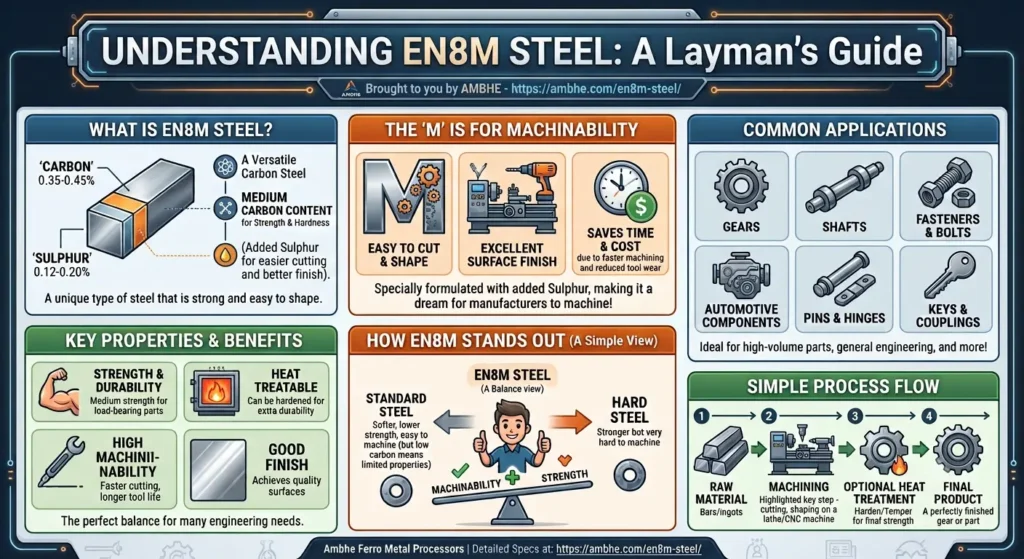
EN8M is the free-cutting version of EN8, supplied to BS 970 as 212M36. Sulphur is added deliberately, to between 0.12 and 0.20%, and the manganese is raised to tie that sulphur up as manganese sulphide. Those sulphide inclusions break the chip as it forms, which is the whole point of the grade.
What a buyer gets is a medium-carbon steel that still carries useful strength, around 700 to 850 MPa after hardening and tempering, but cuts far faster than plain EN8 on a lathe or a CNC bar-feed. Turned and milled parts come off in shorter cycles, tools last longer, and the surface finish needs less rework.
The trade-off is real and worth stating up front. High sulphur costs you transverse ductility and makes the grade a poor choice for welded assemblies. Specify EN8D instead for any part that gets welded, forged heavily, or loaded across the bar axis.
Ambhe Ferro manufactures and supplies EN8M from its own mills in Maharashtra, India, rolling black bar at Unit 1 and drawing it to bright bar at Unit 2, in rounds and hexagons.
Need EN8M bar? Tell us the size and quantity.
Rounds 23.5 to 80 mm, bright bar 22 to 63.5 mm, hexagons 22 to 52.5 mm. Minimum 5 MT per size, rolled at our own mills in Maharashtra and dispatched with a heat-wise test certificate.
Applications
EN8M goes into parts that are made in quantity on automatic lathes and machining centres, where cycle time drives the cost more than the last 50 MPa of strength does.
Typical work includes shafts, spindles, studs, bolts, nuts, pins, keys, couplings, hydraulic fittings, hinge pins and general turned components. Automotive and agricultural machine shops take a good share of it, and so do fastener makers and component machining units.
Light-duty gears are within reach when the drawing allows a free-cutting grade. Heavily loaded gear work is not, because the sulphide inclusions that make the steel cut well are also crack initiation sites under repeated bending. A case-hardening grade such as 20MnCr5 or 16MnCr5 belongs on that drawing.
Our note on cost saving with free-cutting bar works through where the machining time saved outweighs the higher price per tonne.
Sizes we offer in EN8M
- Rounds, black, 23.5 mm to 80 mm
- Bright bar, 22 mm to 63.5 mm
Chemical composition
| Element | Percent by mass |
|---|---|
| Carbon (C) | 0.35 to 0.45 |
| Manganese (Mn) | 1.00 to 1.30 |
| Silicon (Si), max | 0.25 |
| Sulphur (S) | 0.12 to 0.20 |
| Phosphorus (P), max | 0.060 |
Sulphur between 0.12 and 0.20% is what defines the grade. Plain EN8 holds it below 0.060% and EN8D below 0.040%, so EN8M carries roughly three to five times the sulphur of either. Manganese is kept above 1.00% so that the sulphur forms manganese sulphide rather than iron sulphide, which would make the bar crack at rolling temperature.
Our carbon runs from 0.35 to 0.45%. The top of that band sits above the 0.40% ceiling written into 212M36 and reaches into the range of 212A42, the grade the trade calls EN8DM. If your drawing calls out 212M36 with a hard carbon ceiling, say so at enquiry stage and we will confirm the heat against it before dispatch.
Heat-wise figures for your consignment are printed on the Mill Test Certificate. Our page on alloying elements covers what each addition does.
Mechanical properties
As rolled:
| Property | Value |
|---|---|
| Tensile strength (UTS) | 550 to 850 MPa (80,000 to 123,000 psi) |
| Yield strength (0.2% proof) | 495 MPa min (71,800 psi) |
| Elongation (on 5d) | 16% min |
| Impact, Charpy V-notch at room temperature | 28 J min |
| Brinell hardness | 201 to 255 HB |
After heat treatment:
| Condition | Tensile strength, MPa | Yield strength, MPa | Elongation, % | Hardness, HB |
|---|---|---|---|---|
| Normalised | 600 to 750 | 500 min | 14 to 17 | 170 to 220 |
| Hardened and tempered | 700 to 850 | 500 to 650 | 12 to 15 | 200 to 280 |
Take these as typical values for guidance. The numbers that apply to your material are the ones on the test certificate issued against the heat number.
Two qualifications matter when reading the table. Section size changes the result, because a plain carbon steel cannot hold at the core the hardness it reaches at the surface, and the effect grows with diameter. Elongation and impact figures are also measured along the bar. Across it, the sulphide stringers that make EN8M machine well pull those numbers down noticeably, which is why the grade is specified for turned parts rather than for anything loaded transversely.
Heat treatment
| Operation | Cycle |
|---|---|
| Normalising | 850 to 880 °C, air cool |
| Annealing (sub-critical) | 650 to 700 °C, slow furnace cool |
| Hardening | 830 to 860 °C, oil quench |
| Tempering | 550 to 660 °C, air cool |
| Stress relief | 550 to 650 °C, slow cool |
Most EN8M leaves the mill as rolled and is machined in that condition. The grade does respond to heat treatment, though, and the cycles above are the usual starting point. Adjust them for section thickness and for the hardness band written on the drawing.
Tempering temperature sets the final hardness. Across the 550 to 660 °C range, EN8M comes out between roughly 280 HB and 200 HB, with the lower tempering temperatures giving the higher figure. Above that band the drawing is asking for a surface condition rather than a through one: EN8M induction or flame hardens to 50 to 55 HRC at the case with the core left soft, which suits shafts running in bushes and pins that wear at one diameter.
Anything that has to hold much above 35 HRC right through a heavy section is asking for an alloy steel. SAE 4140 is the usual answer. We also supply bar already hardened and tempered or annealed where the drawing calls for it.
Machinability
Machinability is the reason this grade exists, so it is worth putting a number on it. On the standard comparison scale that rates free-cutting 1212 at 100%, EN8M sits at about 72%. The plain carbon grades it competes with are well below that: 1040 and 1042 rate 64% and 1050 rates 54%.
| Grade | Nearest AISI | Machinability |
|---|---|---|
| En1a | 1213 / 1215 | 136% |
| EN8M | 1137 | 72% |
| SAE 4140, annealed | 4140 | 66% |
| EN8D | 1040 / 1042 | 64% |
In practice that gap shows up three ways: shorter cycle times, longer intervals between tool changes, and a cleaner finish straight off the tool. Chips break into short curls instead of stringing into a bird’s nest around the workpiece, which is what lets a bar-fed machine run unattended.
Two things move the number. Normalising before machining gives a more even structure and cuts better than as-rolled bar. Machinability then falls as tempered hardness climbs, so a part taken to the top of its hardness band costs more in tool life than the same part left soft.
The full machinability comparison chart lists rates for the common carbon, alloy, stainless and tool steels. There is more background on the metallurgy in our note on free cutting steel.
Forging and welding
EN8M is bought to be machined, not to be forged or welded, and the chemistry that makes it cut well is what limits it elsewhere.
Welding is not recommended. Sulphur at 0.12 to 0.20% promotes hot cracking in the weld metal and the heat-affected zone, and no amount of preheat reliably fixes it. Where a machined part also has to be welded into an assembly, specify EN8D and accept the slower cycle time, or redesign the joint as a mechanical one.
Forging is possible but rarely the right call. The manganese is high enough to hold the sulphur as manganese sulphide, so the bar will take hot work between roughly 1150 and 1250 °C without tearing, but the sulphide stringers elongate with the metal and leave poor properties across the grain flow. Forge shops that come to us for medium carbon bar are usually better served by EN8D or 35C8. Our forging page covers what we supply into forge shops and in what condition.
International equivalents
| Standard | Designation |
|---|---|
| BS 970 (current) | 212M36 |
| BS 970 (legacy) | EN8M |
| AISI / SAE | 1137 / 1139 |
| DIN / EN | 36SMn14 (1.0764) |
| JIS G4804 | SUM41 |
| AFNOR | 35MF4 / 35MF6 |
| UNI | 4838 |
Treat these as close matches for enquiry purposes rather than as substitutions. Sulphur and manganese ranges differ between standards, so order to the standard printed on the drawing and check the analysis on the test certificate.
One neighbour causes regular confusion. EN8DM, designated 212A42, is the same free-cutting family but carries 0.40 to 0.45% carbon, so it runs harder and slightly less machinable than 212M36. It is a different grade from EN8D, which is 080M40 and not free-cutting at all, despite the similar name. We roll EN8DM to order; send the requirement through our other grades page.
There is a fuller grade datasheet on our dedicated EN8M steel site.
EN8M compared with EN8D
The names are close enough that orders get placed for the wrong one. These are not variants of a single grade. They sit in different BS 970 families and are bought for different reasons.
| Property | EN8M | EN8D |
|---|---|---|
| BS 970 designation | 212M36 | 080M40 |
| Sulphur | 0.12 to 0.20%, added on purpose | 0.040% max, kept low |
| Manganese | 1.00 to 1.30% | 0.70 to 0.90% |
| Machinability, 1212 basis | About 72% | About 64% |
| Weldability | Not recommended | Weldable with preheat |
| Forging | Possible, not preferred | Forges well, common forging stock |
| Transverse ductility | Reduced by sulphide stringers | Good |
| Bought for | Machining throughput | Strength, weldability, forging |
Choose on what happens to the bar after it arrives. A part that is turned or milled in volume and then goes straight into service belongs in EN8M, where the machining saving is collected on every piece. A part that gets welded, forged, or loaded across the bar belongs in EN8D, and the extra machining cost is the price of those properties.
Strength is close enough not to decide it. Both land in the same 700 to 850 MPa band after hardening and tempering.
EN8M compared with En1a
Buyers who want speed on the machine often start by asking for En1a, so it helps to know where the line falls.
En1a is a low-carbon free-cutting steel, 230M07, with carbon under about 0.15%. It machines close to twice as fast as EN8M and is the cheaper grade to cut. What it cannot do is carry load. Yield strength sits well under half of EN8M’s, and there is not enough carbon in it to harden and temper to any useful figure.
So the split is simple. For low-stress turned parts, spacers, bushes, small fittings and anything where the drawing has no strength callout, En1a is the right specification and EN8M is money wasted on machining time. Once the part has to take real load, or has to be hardened, En1a drops out and EN8M is the grade that keeps most of the machining benefit while carrying the strength.
To push throughput further still, En1a leaded cuts faster than either.
Ordering information
To place an order we need the following.
| Grade | EN8M (BS 970 212M36) |
|---|---|
| Order | Minimum order 5 MT per size |
| Length |
|
| Sizes |
|
| Condition |
The full size range page lists everything we roll across all grades. Sizes outside the standard list can be developed where the requirement is regular and the quantity supports it.
To request a quote, fill in this form.
EN8M steel supplier and manufacturer in India
Ambhe Ferro Metal Processors Private Limited is an EN8M steel manufacturer and supplier working from its own rolling and drawing mills in Maharashtra, India. The plants sit close to JNPT port and to the consumption centres of Mumbai, Thane, Pune, Nashik, Ahmednagar and Aurangabad.
Black bar is rolled at Unit 1 and drawn to bright bar at Unit 2. We roll rounds, bright bars, hexagons and RCS across the size range listed above, to domestic and international specifications. Because we roll the material ourselves rather than trading it, the heat behind your consignment is ours and the test certificate is issued against it.
As an EN8M supplier we ship into Mumbai and its belt at Vasai Virar, Mira Bhayandar and Navi Mumbai, into Pune at Pimpri Chinchwad, Chakan, Bhosari and Ranjangaon, into Aurangabad at Waluj and Chikalthana, and into Nashik at Ambad, Satpur and Sinnar. Other regular destinations are Ahmednagar, Thane, Ambernath, Rabale, Umbergaon, Rajkot, Ahmedabad, Nagpur, Kolhapur, Sangli, Belgaum, Bengaluru, Goa and Chennai. Export shipments go out through JNPT.
Testing and packaging
Every heat we roll in EN8M is tested before dispatch. Chemistry is checked on the spectrometer and mechanical properties on the tensile and hardness machines, with visual and dimensional inspection on the finished bar.
On request we add ultrasonic testing, magnetic particle inspection, macro and micro examination, grain size determination and a decarburisation check. Third party inspection can be arranged.
A heat-wise Mill Test Certificate ships with every consignment, listing chemistry and mechanicals against the heat number. Finished bars are bundled with steel strapping, end-tagged with grade and heat number, and protected for road or container dispatch. There is more detail on our quality control page.
Related grades and guides
- EN8M steel datasheet site
- EN8D steel
- En1a free cutting steel
- En1a leaded
- Free cutting steel explained
- Cost saving by using free cutting steel bars
- Machinability of metals
- S45C steel
- SAE 4140 steel
- 35C8 steel
- Alloying elements of steel
- Quenched and tempered bar
- Annealed steel bar
- Steel hexagons
- Quality control
Frequently asked questions
What is EN8M steel?
EN8M is the free-cutting version of EN8, designated 212M36 in BS 970. Sulphur is raised to between 0.12 and 0.20% and manganese to between 1.00 and 1.30% so that the steel breaks chips cleanly during machining. It keeps useful medium-carbon strength, which is what separates it from the low-carbon free-cutting grades.
What does the M in EN8M stand for?
The M marks a free-machining grade. In BS 970 it means sulphur has been added on purpose to improve machinability, which is why EN8M and plain EN8 sit in different families, 212M36 against 080M40.
What is the chemical composition of EN8M?
Ambhe supplies EN8M at 0.35 to 0.45% carbon, 1.00 to 1.30% manganese, 0.25% silicon maximum, 0.12 to 0.20% sulphur and 0.060% phosphorus maximum. The BS 970 212M36 carbon limit is 0.32 to 0.40%, so tell us at enquiry stage if your drawing enforces that ceiling. Heat-wise figures are on the Mill Test Certificate.
What is EN8M equivalent to?
EN8M is approximately equivalent to AISI 1137 and 1139, DIN 36SMn14 (material number 1.0764), JIS SUM41, AFNOR 35MF4 and 35MF6, and UNI 4838. Sulphur and manganese ranges differ between these standards, so confirm the analysis against the test certificate rather than treating them as drop-in substitutes.
What is the difference between EN8M and EN8D?
EN8M is free-cutting with 0.12 to 0.20% sulphur and machines at about 72% on the 1212 scale. EN8D holds sulphur below 0.040% and machines at about 64%, but it welds with preheat, forges well and keeps its ductility across the bar. Specify EN8M for volume machining and EN8D where the part is welded, forged or transversely loaded.
Is EN8M weldable?
Welding EN8M is not recommended. The added sulphur promotes hot cracking in the weld metal and the heat-affected zone. Where a machined part must also be welded, EN8D is the grade to specify.
Can EN8M be hardened?
Yes. Harden at 830 to 860 °C with an oil quench and temper between 550 and 660 °C, which sets hardness between roughly 200 and 280 HB. For a hard surface on a soft core, EN8M induction or flame hardens to 50 to 55 HRC at the case.
What sizes do you supply EN8M in?
Hot rolled rounds from 23.5 to 80 mm, bright bars from 22 to 63.5 mm, black hexagons from 23.5 to 52.5 mm across flats and bright hexagons from 22 to 50 mm across flats. Standard lengths are 5 to 6 metres, with custom cuts on request.
What is your minimum order quantity for EN8M?
5 MT per size. Orders consolidated across several sizes are accepted on a single consignment.
Do you provide a test certificate with EN8M?
Yes. Every consignment ships with a heat-wise Mill Test Certificate listing chemistry and mechanicals against the heat number. Third party inspection can be arranged on request.
Send us your EN8M enquiry
Give us the grade, size, quantity and condition you need, black or bright, and we will come back with a rate and a delivery date. Drawings and specification sheets are welcome at enquiry stage. If you are comparing EN8M against EN8D or En1a for a particular component, tell us what the part does and we will advise.