
ANNEALED STEEL BAR
What Is an Annealed Steel Bar?
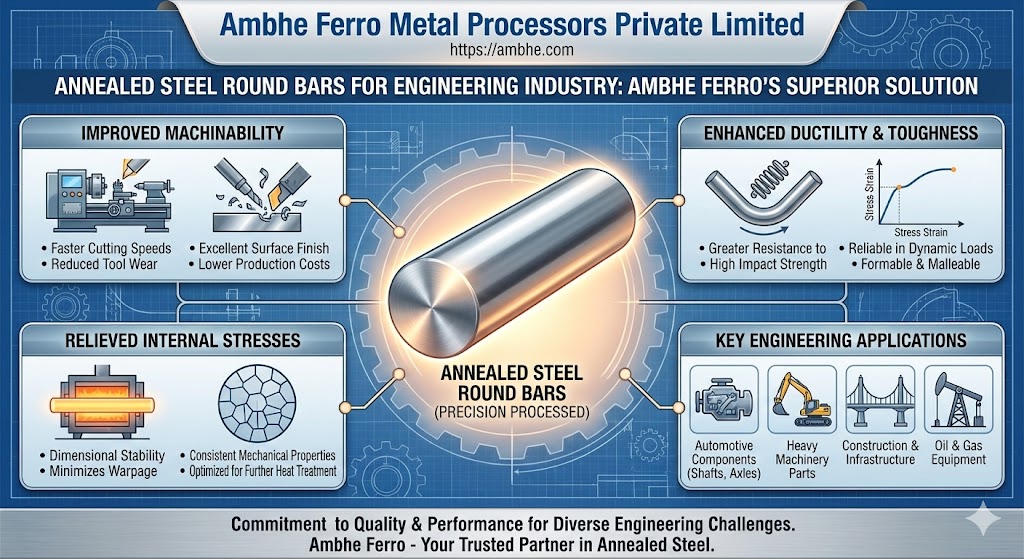
Annealed steel bars are heated, held and slow-cooled on a controlled cycle. The finished bar is soft, low in residual stress and predictable to machine or cold form. Annealing is not one temperature. The cycle is set against the steel’s own transformation points. Full annealing holds the bar above Ac3 and cools it slowly through the transformation range. Soft (spheroidise) annealing holds just around or below Ac1 for several hours so the carbides ball up into spheroids. Stress-relief annealing stays well below Ac1 and changes stress, not structure. Each route gives a different result. The question worth asking is not “can you anneal it” but which anneal, to what hardness, for what next operation.
Ambhe Ferro supplies annealed steel bar in engineering grades including SAE 4140 / 42CrMo4, EN19, 41Cr4, EN8D, C45 / S45C, 1045 (En9), 35C8, 16MnCr5, 20MnCr5 and EN1A. They go out as black hot-rolled rounds, hexagons and squares, or as bright bar.
We roll and finish the bar ourselves, then outsource the heat treatment to qualified partners. We specify the cycle and we inspect the result. Minimum order quantity is 20 MT per size, per grade.
Send us the grade, the size and the hardness or structure you need to hit. We will confirm the route before you commit. Call +91 90040 64570 or email sales@ambhe.com.
Buying Annealed Bar from Ambhe Ferro
Which Annealing Route Do You Actually Need?
Most enquiries that arrive asking for “annealed bar” are really asking for one of five different cycles. Pick the wrong one and the bar machines badly, distorts on the lathe, or cracks in a cold-heading die.
| Route | Symbol | What happens | Ask for it when |
|---|---|---|---|
| Full annealing | +A | Austenitise above Ac3, then slow furnace-cool through the transformation range | You want the softest, most uniform structure before heavy stock removal |
| Isothermal annealing | n/a | Austenitise, cool fast to a fixed sub-critical temperature, hold until pearlite forms, then air cool | You want full-anneal softness with far less furnace time. Common on case-hardening gear steels |
| Soft / spheroidise annealing | +AC | Long hold just below or cycling around Ac1 (roughly 680 to 730 °C) until the carbides become globular | The bar goes into cold heading, cold extrusion or cold forging, or it is a high-carbon grade being machined |
| Stress-relief annealing | n/a | Hold well below Ac1 (typically 450 to 650 °C for carbon and low-alloy steels), then controlled slow cool | Parts move on the machine or after rough turning. Relieves rolling, drawing and welding stress without materially changing hardness |
| Recrystallisation annealing | n/a | Hold above the recrystallisation temperature (roughly 550 to 700 °C) after cold work | Ductility has to be restored between cold-drawing passes |
One note on symbols, because enquiries get this wrong often. Under EN 10083 and EN 10084, +A means soft annealed and +AC means annealed to spheroidal carbides. The two get used as synonyms. They are not the same treatment and they do not give the same structure.
Typical Hardness After Annealing
These are the maximum hardness values the relevant European standards allow in the soft-annealed (+A) condition. Treat them as the starting point for a machining estimate, not as a delivery guarantee. Confirm the band against your own drawing or standard at enquiry stage.
| Grade | Standard | Max hardness, soft annealed (+A) |
|---|---|---|
| C35 / 35C8 | EN 10083-2 | 187 HBW |
| C45 / S45C / EN8D / 1045 | EN 10083-2 | 207 HBW |
| 42CrMo4 / SAE 4140 / EN19 | EN 10083-3 | 241 HBW |
| 41Cr4 | EN 10083-3 | 241 HBW |
| 16MnCr5 | EN 10084 | 207 HBW |
| 20MnCr5 | EN 10084 | 217 HBW |
| EN1A / 11SMn30 | BS 970 | Typically 134 to 149 HB as rolled / annealed |
Why Buy Annealed Steel Bar from Ambhe Ferro
Who Does the Annealing
Ambhe does not run an annealing furnace. The annealing happens at qualified heat-treatment partners, on a cycle we write. We set the soak temperature, the hold time and the cooling rate against your grade, section and target hardness. We chose that route deliberately rather than run a general-purpose furnace badly. A dedicated heat-treatment plant holds a temperature uniformity that a rolling mill’s reheating furnace never will. Four things stay with us: the specification, the choice of partner, the inspection, and the commercial responsibility if the bar comes back wrong. You get the cycle and the test record with the material, not a delivery note that says “annealed”.
What We Test Before Dispatch
The checking is ours. Our Unit 1 laboratory runs an optical emission spectrometer, a digital Brinell tester (500 to 3000 kgf), a Rockwell tester and a 600 kN universal testing machine. An NABL-accredited agency calibrates all of them. We test treated bar here before it ships, so the outsourcing stays our problem rather than yours. For high-alloy grades we also have vermiculite slow-cooling on the mill. It keeps hardness spikes and hydrogen-related defects out of the bar long before it reaches a heat-treatment furnace. Our quality control page covers the wider test plan.
What You Get From Properly Annealed Steel Bar
A properly annealed steel bar gives you a softer and more uniform matrix. That means smoother chip formation, longer insert life, and much less variation in hardness between bars of the same heat. That last point is usually worth more than the softness itself. Bar-to-bar variation is what forces machine shops into conservative feeds and speeds. The same uniformity makes later quenching and tempering or carburising repeatable across a batch. It is also why annealed stock machines to a more predictable cost per part.
We straighten and re-inspect bars after treatment. Finish options are black, turned and peeled, drawn and polished, or centreless ground. Rolling and bright-bar finishing are ours and heat treatment is our partners’. Grade, size, condition, finish and certification still sit on one order with one supplier. We dispatch from Maharashtra to buyers across India.
Typical Supply Range (Indicative)
| Rounds | 23.5 mm to 80 mm, in 36 standard sizes. Other sizes are developed against a regular requirement. |
| Hexagons | 23.5 mm to 52.5 mm |
| Squares | 22 and 28 mm standard, 25 to 42 mm on volume |
| Bright bar | 22 mm to 63.5 mm |
| Cut length | 5.5 to 6 m standard. Fixed and cut-to-length pieces on request. |
| Conditions | +A (soft annealed), +AC (spheroidised), stress-relieved, and +QT (quenched and tempered) |
| Finishes | Black (as-rolled), turned and peeled, drawn and polished, centreless ground |
| Straightness | Agreed per order. Tell us the class you need and we will confirm it against the finish you have chosen. |
| Hardness | Grade-dependent. See the table above. |
| Minimum order | 20 MT per size, per grade |
Full dimensional detail is on the Size Range page.
What to Send With Your Enquiry
Send these and we can usually confirm feasibility in the first reply:
- Grade and the standard it is called to, plus the actual chemistry if you have a mill certificate
- Diameter or section, and length
- Condition required, meaning +A, +AC or stress-relieved. If you are not sure, tell us the operation the bar goes into next and we will pick.
- Target hardness band, or the microstructure your drawing calls for
- Finish (black, peeled, drawn or ground) and any decarburisation limit
- Test and certification plan: chemistry, hardness, mechanical properties, NDT if required
- Quantity per size and per grade, and the delivery schedule
Where Annealed Steel Bar Is Used
Annealed steel bar is the normal starting stock wherever the next operation removes a lot of metal or deforms the steel cold. Typical parts are gears and pinions, shafts and spindles, hydraulic and pneumatic components, cold-headed and cold-forged fasteners, forging stock, machined components on automatic and CNC machines, and bearing and housing parts. The Applications page lists the industries we supply.
Frequently Asked Questions
1. What does annealing actually do to a steel bar?
It lowers hardness, raises ductility, relieves residual stress and makes the structure more uniform along and across the bar. In practice you get a bar that machines and cold-forms predictably, and that responds consistently to later heat treatment.
2. Is annealed the same as normalised?
No. Both start by heating above Ac3, but normalising cools in still air and annealing cools slowly in the furnace. Normalising gives a finer grain and a harder, stronger bar. Annealing gives a softer, more machinable one. If your drawing says +N, do not substitute +A.
3. What is the difference between +A and +AC?
+A is soft annealing, the general-purpose softening treatment. +AC is annealing to spheroidal carbides, a long sub-critical hold that turns lamellar carbides into globules. Cold heading, cold extrusion and cold forging need +AC. For machining, +A is usually enough.
4. Do you anneal in-house or outsource it?
We outsource it. Ambhe rolls and finishes the bar, and the annealing itself is done at qualified heat-treatment partners on a cycle we specify. What stays with us is the specification, the incoming and outgoing inspection, the test certificate and the responsibility if the bar is not right.
5. Do annealed bars really machine better than as-rolled bars?
For medium-carbon and alloy grades, yes, in tool life and in consistency both. Consistency is usually the bigger gain. As-rolled bar can vary in hardness bar-to-bar and end-to-end, and that variation forces conservative feeds and speeds. Very low-carbon free-cutting grades are the exception, where an over-soft structure can smear and give a poorer surface finish than as-rolled.
6. Can an annealed bar be hardened and tempered later?
Yes, and it is a common route: anneal, rough machine, harden and temper, then finish machine. Annealed steel bar is in fact the preferred starting condition, because a uniform structure going in gives a uniform result coming out. See Quenched and Tempered Bar.
7. What hardness should I expect after annealing?
It depends on the grade. The standards cap soft-annealed hardness at 187 HBW for C35, 207 HBW for C45 and 16MnCr5, 217 HBW for 20MnCr5, and 241 HBW for 42CrMo4 and 41Cr4. Tighter bands can usually be agreed. Tell us the window your process needs.
8. Does annealing change the size or straightness of the bar?
It can. Any full heat-treatment cycle releases stress, and long slender bars will move. That is why we straighten and re-inspect bars after treatment. Where the tolerance is tight, leave the final peeling, drawing or grinding pass until after annealing.
9. Do you supply annealed bright bar as well as black bar?
Yes. Bright bar is supplied 22 mm to 63.5 mm in turned and peeled, drawn and polished, or centreless ground finish. Where the bar has been cold drawn, a stress-relief cycle often beats a full anneal. It keeps the drawn strength while removing the drawing stresses that make parts move on the machine.
10. Which grades can you supply in the annealed condition?
The regular list is SAE 4140 / 42CrMo4 / EN19, 41Cr4, EN8D, C45 / S45C, 1045 (En9), 35C8, 16MnCr5, 20MnCr5, EN1A and EN1A leaded, along with IS 2062 and ST52-3 structural grades. Other grades are available against a firm requirement, so ask.
11. What is the minimum order quantity?
20 MT per size, per grade. Annealing is a batch process and bars are treated in furnace lots. A mixed pallet of small quantities cannot be run economically or held to one consistent hardness. If your enquiry covers several diameters or several grades, each line needs to reach 20 MT in its own right.
Talk to Us
For annealed steel bar enquiries, call +91 90040 64570 or email sales@ambhe.com. Ambhe Ferro Metal Processors Pvt. Ltd., 1214-1216, The Epicentre, Best Colony, Chembur (E), Mumbai 400071, India.